How to Write Content That AI Models Actually Cite?
This is the writing deep dive behind the pillar guide, Getting Cited in AI Search. The pillar covers the whole path: whether AI systems can read your site, whether your pages survive query fan-out, and whether you are trusted enough to be named. This article goes further into one part of it: how to write sentences that can be lifted out and cited.
For years the goal was simple: rank first, get the click, turn the visitor into a customer.
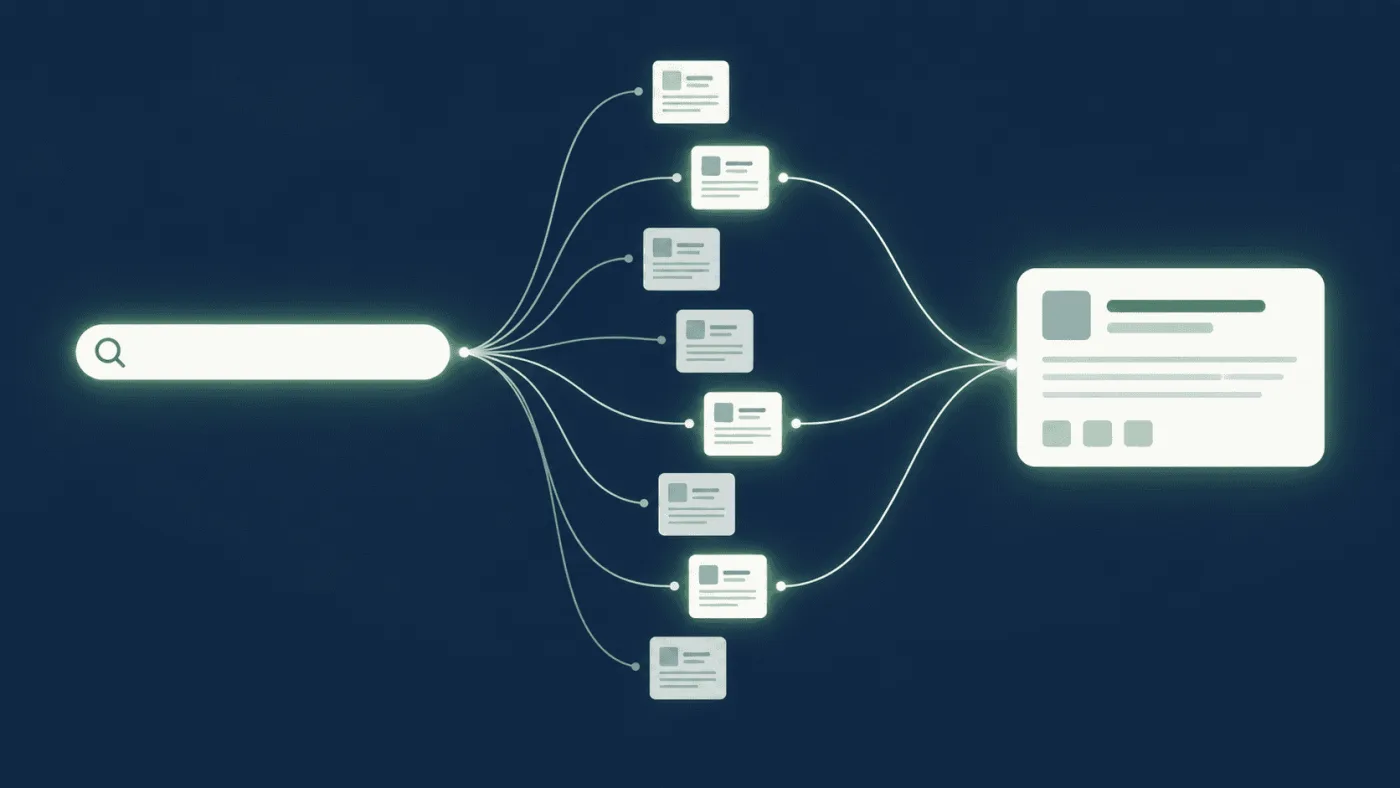
Now there's another layer between you and that visitor. Someone asks an assistant a question, the assistant reads through a handful of sources and stitches together an answer. If you're in that answer, you exist. If you're not, you don't, no matter how well you'd have ranked in a classic search.
That doesn't change everything. But it changes one important thing: you're no longer writing just for a person who reads. You're writing for a system that extracts. And those two readers have different habits.
This is about those habits, and about how to write something that can actually be lifted out and cited.
Table of contents
- Why a model decides to cite someone
- What actually changes in how you write
- The technical side: what to check, and where it lives
- How to tell if you're actually being cited
- What not to do
- What actually pays off
Why a model decides to cite someone
There's no public rulebook, but a few patterns show up consistently in how these systems behave.
A model doesn't rank your page the way a search engine does. It looks for claims it can pull out and drop into an answer with as little risk of being wrong as possible. That means it isn't looking for the best text. It's looking for the most usable one.
Usable, in this context, breaks down into a few concrete things.
The claim is self-contained. You can lift it out of the paragraph and it still makes sense. If your key sentence reads "as we explained earlier, this depends on several factors," there's nothing to lift.
The claim is specific. A number, a deadline, a condition, a name. "The appeal deadline is fifteen days from receiving the decision" is citable. "The deadline is fairly short" is not.
The context sits next to the claim, not three paragraphs above it. Models work with chunks. If a sentence says "in that case, a fee applies" and "that case" was defined two sections earlier, the chunk is useless on its own, and it gets skipped.
The source reads as reliable. There's an author, a date, the claims are backed up, and what's written lines up with what's written elsewhere. A model is unlikely to cite an isolated claim that contradicts everything else it's seen, even if that claim happens to be true.
That's roughly it. Nothing mystical. You write so your sentence can be safely retold.
What actually changes in how you write
The answer goes at the top, not the bottom
Classic writing builds tension: intro, context, development, conclusion. That's good for reading and bad for extraction.
A better layout: state the question, answer it in two or three sentences, then everything else. A reader who knows what they want gets it immediately. A reader who wants depth keeps going. And a system pulling text finds a complete claim right at the top of the section, exactly where it's cheapest to grab.
Don't do this as a dry summary bolted onto the top of the article. Do it inside every section. The first sentence carries the point, the rest is development.
Headings should ask or state, not label
"Pricing" is a label. "How much does it cost to register a company in Kosovo" is a question a real person actually types.
The second one carries meaning on its own. When a model scans a document's structure, the heading is the cheapest way for it to figure out what a section covers. A label tells it nothing.
Same logic applies to claims as headings: "Registration takes three to seven days" beats "Processing time" as a heading, every time.
The questions that make the best headings are the ones your audience actually asks. The pillar shows where to find them, including the follow-ups an AI system generates from a single question.
One idea, one paragraph
A paragraph carrying three different points can't be cited for any of them cleanly. Split it up.
This happens to help human readers too, which is a rare case where the two interests line up without a trade-off.
Numbers instead of adjectives
This is the single biggest win available.
Compare "the process is fairly quick and doesn't cost too much" with "the process takes five to ten business days and costs around a hundred euros." The first sentence has nothing that can be transferred anywhere. The second is a finished answer.
A rule worth keeping: every section should carry at least one checkable number, date, or name. If it doesn't, the section probably isn't saying anything concrete.
There is some evidence behind this. The pillar cites the Princeton-led study that coined the term generative engine optimization, which found that adding statistics, quotations and citations raised a source's visibility in generative answers by more than 40 percent. It tested generative engines in general rather than AI Overviews specifically, so treat it as a strong direction, not a guarantee.
Define terms where you use them
If you're writing about something with a name, write the one sentence that says what it is, even if you assume everyone already knows.
That sentence often ends up being exactly what gets cited, because a model treats it as solid ground for building an answer. It costs you one line.
Say what doesn't work and where the limits are
This sounds like the opposite of good marketing, and it tends to serve you better than good marketing.
Text that says "this doesn't apply to companies registered before 2020" or "this approach won't help if the problem is your data" gives the system precisely what it needs for a precise answer, and it gives a human reader a reason to trust you.
Content that's entirely upbeat reads as promotional and tends to be treated more cautiously. That doesn't mean you can't take a position. It means the position needs an edge to it.
The technical side: what to check, and where it lives
Most of the technical layer is covered in depth elsewhere, so here is the short version, with pointers.
The page has to be readable without running scripts. If content only appears after everything loads in the browser, whatever's reading the page on the model's side never sees it. Old advice, new consequence. The pillar explains the two-minute check, and Query Fan-Out and AI Crawlers: A Deep Dive for Nonprofits covers rendering in section 4.
Structured data still helps, mainly because it removes ambiguity. Who's the author, when it was published, when it was last updated, which organization is behind it. That's not a ranking trick. It's making something already on the page unambiguous. The deep dive has a working JSON-LD example and a page-type map in section 6.
Date your content, and put both dates in the markup. When an answer depends on how current something is, and a lot of answers do, undated content loses to dated content. Mark up datePublished and dateModified in your Article schema, which is the cleaner place to signal an update. The pillar explains why showing both dates to readers on the page can backfire in regular search.
Give the author a real name and a bio. Not for the sake of form, but because reliability gets judged partly by who's standing behind the text.
Decide deliberately who gets to read you. Different systems respect different access rules, and it's possible to block exactly the ones you'd want reading you. The short version, which matches the pillar: allow the search and answer crawlers, block training bots only if you have a concrete reason, and don't use Google-Extended as your Google control. Section 4 of the deep dive has the full table and a robots.txt to start from.
How to tell if you're actually being cited
Standard analytics don't help much here, since a citation often doesn't generate a click. The pillar describes the full method: the Search Console AI performance report, a monthly prompt panel of real questions run through several assistants, and server logs. I won't repeat it here. Two points from the writing side are worth adding.
Watch how you get paraphrased, not just whether you get mentioned. If a model misstates your claim, the cause is almost always in the text. Something was ambiguous, the context sat too far away, or the claim leaned on something said earlier. That's the most useful feedback you'll get from this whole exercise.
Track whatever traffic does arrive from these systems, however small the number. It's usually small, but it tends to be higher intent. Someone arrives after already getting an answer and wants more.
And keep tracking classic search. It hasn't gone anywhere, and for most sites it still brings in most of the traffic. This is an additional layer, not a replacement.
What not to do
A few things already circulate as "tactics" that carry more risk than payoff. Hidden text meant only for machines, and piles of questions and answers with nothing behind them, are covered in the pillar's "What I'd skip" list. Two more belong here.
Publishing large volumes of generated text. If your content is assembled from the same sources a model already has access to, you have nothing to offer. What gets cited is what exists nowhere else: your data, your experience, your numbers. AI Search Content Optimization looks at why volume is the most common false shortcut.
Forgetting that a human still reads this. Text optimized purely for extraction ends up choppy, dry, and nobody shares it. And if nobody shares it, over time it loses the trust signal that would have made it worth citing in the first place. The pillar makes the same point about chunking: write clear sections because people scan, and let the machine benefit come along for free.
What actually pays off
If you boil all of this down to one thing, it's this: have something others don't, and say it clearly and specifically.
Your own field data. Your pricing. Your process, laid out step by step with actual timelines. What you tried that didn't work. A number from your last project.
That's the only content a system can't assemble from other sources, and that's the only reason it has to name you at all.
Everything else, structure, headings, dates, structured data, exists to make that one thing easy to find and safe to pass along. Useful, but only if there's something worth passing along underneath it.
For the full sequence, including reporting and a step-by-step plan for a small team, continue with the pillar: Getting Cited in AI Search.